Rail Connectivity
Traveling between Switzerland, northern Italy and Germany immediately transforms your worldview of what rail connectivity means. Suddenly every town with a rail station becomes well-connected with larger urban centers. In a country like Morocco, where rural-urban migration is an important challenge, rail connectivity would go a long way to easing those challenges.
Economically, the advantages from increased coonnectivity can be explained by the network effect. There are increasing returns to scale in trip volume when there are more origin-destination combinations. Furthermore, the increased connectivity can have relatively benificial operational congruencies with the more high-volume large-city trunk routes.
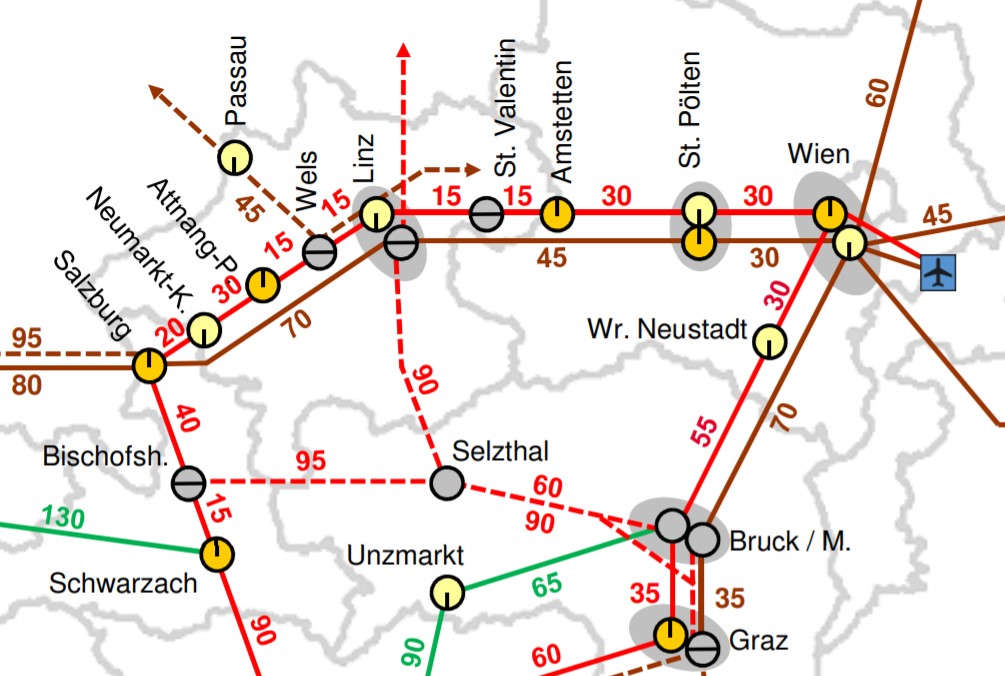
The image shows an example of using a “takt” based schedule, in this case in Austria, to achieve a dense rail network without needing to run too many trains on each of the smaller branch lines because of timed clock-face transfers. When a network pulses, that is the lower frequency route has a timed transfer to the higher frequency one, you have now created essentially an almost one-way trip that can reach anywhere on the network. Marco Chitti has a brilliant exposition on such type of planning.
The connectivity can also go a long way of promoting local investment. When secondary and peripheral cities feel connected to the urban fabric of the country, its inhabitants are more easily able to build cross-regional links and are rewarded in their ability to invest locally.
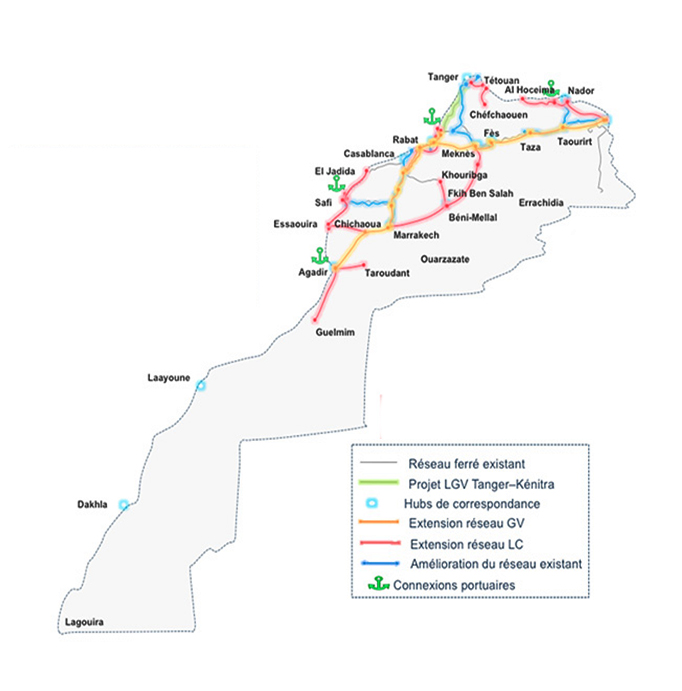
ONCF has a roadmap plan to connect a large portion of Morocco by 2040. It is an ambitious plan that would be a great start. The importance of connecting secondary towns to the larger high speed rail trunks, Tangier-Rabat-Marrakech-Agadir and Rabat-Fes-Oujda, would do wonders in galvanizing rail transport.
Luckily for Morocco, it is not too widely dispersed a country. It is perfectly sized to have rail connectivity of various modes (high speed, regional rail, suburban rail etc). Benchmarking with the pre-Covid combined annual passenger rail volume of Belgium and the Netherlands, the two countries acheived 253.0 million rail journeys and 388.9 million rail journeys. A combined total of ~642 million, for a population total of approximately ~30 million people. Relative to Morocco, ONCF carried 38.2 million passengers pre-Covid, a greater than 15x magnitude difference for a smaller combined population than Morocco.
Morocco luckily has inherited and continues to develop a rail system. It has a national operator keen to expand and grow its system. Benchmarking suggests that there is a lot of latent demand for rail travel to tap into. As a form of infrastrucure, rail is well suited to project finance capital that can help Morocco get there. The economic returns, both directly from operational revenue and indirectly from economic spillovers should support the case for rail investment as an economic priority.