Green Spaces
The ability of urban green spaces to radically transform a city cannot be understated. In particular, it’s not simply having a solitary mega urban park that makes a city have green spaces, though not to discount the functionality of a Central Park in Manhattan or a Golden Gate park in San Francisco. It’s the plethora of trees creating shade, of sidewalk shrubs and gardens, of natural paths and small parks that provide access to a green space throughout the city that truly creates a city with urban green spaces.
Take for example Rabat, Morocco. Objectively for large Moroccan city standards, it has more green spaces than Casablanca, Marrakech and similarly medium-large Moroccan cities. But a lot of that is concentrated within specific large areas, from the Ibn Sina forest, its forested green belt and to the paths along the Bouregreg, these are larger green spots that are not walkably accessible from most residential areas. The city also has some urban streets with tree cover, but many neighborhoods lack the consistency of tree cover, sometimes only limited to large wide boulevards that connect between neighbourhoods and not along streets within a neighbourhood.
Together this contributes to a disjointed green city. Where inequality in green space access can make the city radically different in liveability. Neighbourhoods such as L’Océan or Agdal, are dense and walkable, but lack uniformity in green cover.
Stepping back, one not need to search for very long to document the vast benefits of urban green spaces. From reductions to noise pollution (many studies show the negative impact of living near noisy roads), to promoting walkability and bikeability (countless physical excerise health benefits), to climate impacts (reducing urban heat zones) and to direct economic ones (domestic and touristic appeal in attracting consumption spending). There’s no doubt that a city with widespread green spaces is healthier and overall benefits its inhabitants compared to one without. Similar to urban cycling infrastructure, green spaces are another form of low-cost, high-value urban transformations. Their benefits (both social and economic) are high, while their fiscal cost is low. The main challenge is inspiring the civic duty and awareness in producing them.
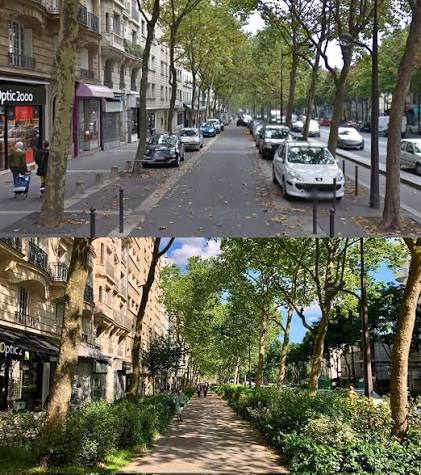
Compare the before and after of rue Toulouse in Paris. One is inviting the other makes you want to escape it as soon as possible…
Or take a particularly hot city, like Marrakech. Imagine a greener, walkable Marrakech, with pedestrian zones free of its mayhem of cars and motorbikes. With its summer heat, a shady cool Marrakech would do wonders for its inhabitants and would massively increase both its appeal to its own residents and would open up a greater touristic appeal during its hot summer months.
Greener cities are one of the most bang-for-buck urban policies that city governments can implement. For developing countries, where budget constraints bind much more, it offers a path to high quality liveability improvements while preserving precious funds for more capital intensive infrastructure. As a form of policy, it can complement and rarely need to substitute or compete with other policy initiatives.